- (808) 799-5747
- sales@pearlharborofficial.com
- Honolulu, Hawaii 96815
© 2026 Pearl Harbor Official. All rights reserved.
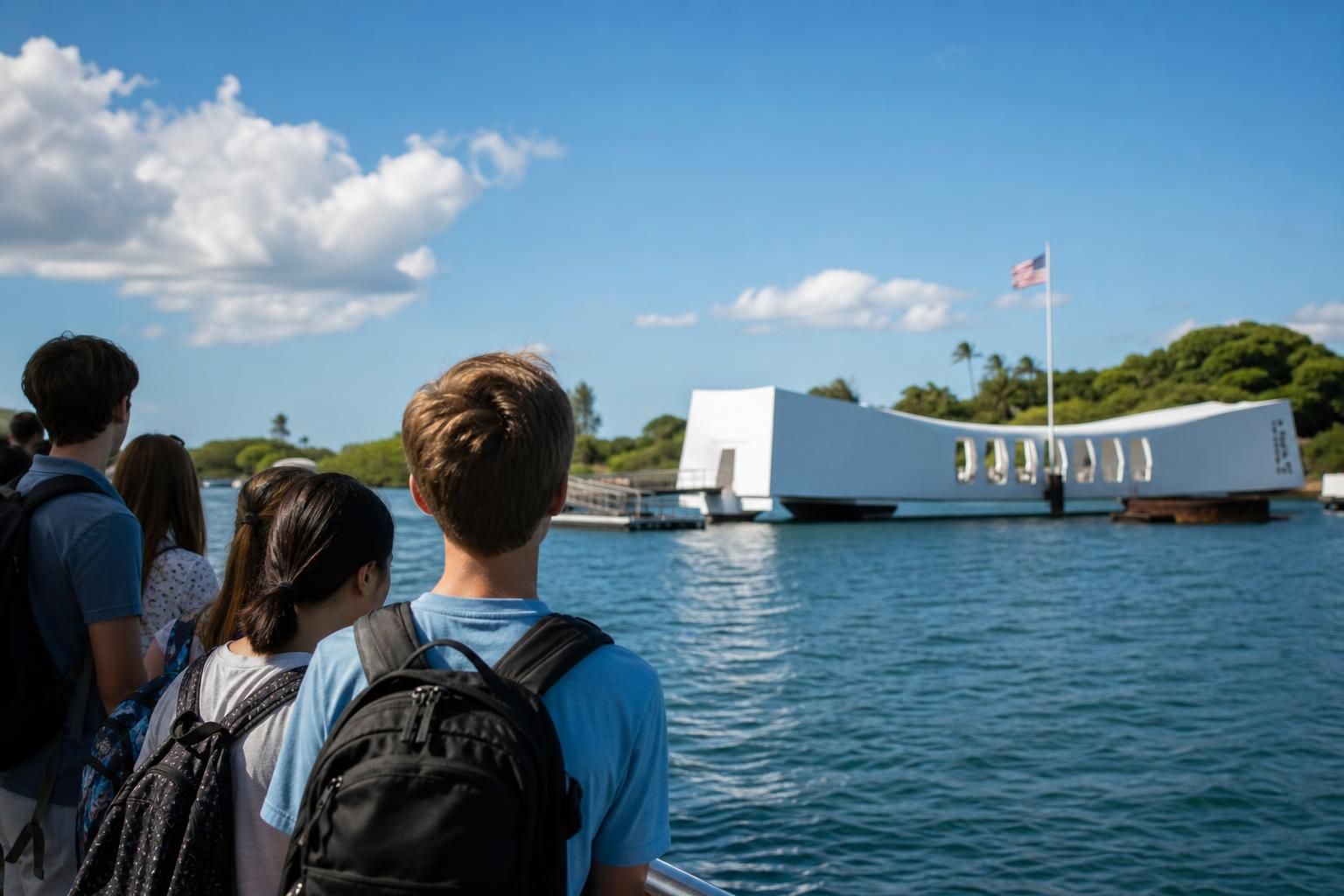
A Pearl Harbor tour for school groups on Oahu should combine a reserved USS Arizona Memorial boat ticket, a guided bus tour with hotel or school pickup, and a chaperone-to-student ratio that satisfies both the school’s policy and the National Park Service’s group visitation rules. Group leaders typically need to book memorial tickets weeks in advance, since the Pearl Harbor National Memorial issues a limited number of same-day tickets and educational groups compete with individual travelers for the same time slots. Building in extra time for security screening and site orientation keeps a student trip running smoothly.
Key takeaways
Pearl Harbor is one of the few places in the country where students can stand at a still-active U.S. Navy base and see a preserved historic site connected directly to a documented national event. The USS Arizona Memorial sits above the sunken battleship where more than 900 sailors and Marines remain entombed, and the site is administered jointly by the National Park Service and the U.S. Navy. For many students, this is their first encounter with primary-source history rather than a textbook account, which is part of why the location draws school groups from across the country and internationally.
Teachers planning a unit on World War II, U.S. foreign policy, or military history often pair the visit with pre-trip reading so students arrive with context for what they’ll see at the museum galleries and memorial.
Group tours built for schools generally bundle several pieces that would otherwise require separate reservations:
Some schools also add the Battleship Missouri Memorial, where Japan’s formal surrender was signed in 1945, giving students a bookend to the story that began with the attack on December 7, 1941. Groups deciding how much to fit into one day may find it useful to compare a half day versus full day itinerary before finalizing the schedule, since a full day allows time for both the memorial and Ford Island sites without rushing.
The National Park Service releases USS Arizona Memorial tickets in phases, and walk-up availability can disappear before a bus of 30-plus students even arrives. For a scheduled school trip, this makes advance reservation essential rather than optional. Group organizers should:
Groups that wait until the week before often find their preferred time slot gone. Anyone who has already run into this problem should look at the options for what to do when tickets are sold out, since standby lines and alternate-site plans exist but require flexibility.
Most Hawaii Department of Education field trip policies and comparable mainland district policies require a minimum adult-to-student ratio, commonly in the range of 1:10 for middle and high school groups, though schools should confirm their own district’s specific requirement rather than assume a number. The memorial grounds and boat ride also have their own rules: bags larger than a small clutch are not permitted inside the visitor center per National Park Service guidelines, so schools should tell students in advance to leave backpacks on the bus. A locker or bag-check option is typically available near the entrance for anyone who arrives with a prohibited item.
Because the USS Arizona is a war memorial and gravesite, staff and volunteers ask visitors to keep noise low and phones on silent once aboard the boat and standing over the sunken hull. Preparing students for this tone ahead of time — explaining that it’s treated similarly to a national cemetery — helps avoid awkward moments during the visit itself.
Schools have two main booking paths: joining a scheduled public tour departure alongside other travelers, or arranging a private or custom group tour reserved exclusively for the school. A private charter gives more control over departure time, bus size, and the ability to combine stops (memorial, museum galleries, Battleship Missouri) into one continuous school-day schedule instead of working around a public tour’s fixed timing. Larger schools coordinating multiple classrooms or grade levels often lean toward a private option specifically because it simplifies headcount and chaperone check-ins at a single pickup point. Pearl Harbor Official offers both public and custom group tour formats with hotel pickup available for schools housing students at Waikiki or Ko Olina properties during a trip to Oahu.
Groups still deciding on logistics and budget may want to review a general starting point for comparing Pearl Harbor tour options before committing to a public or private format, since the right choice depends on group size and schedule flexibility.
A short pre-briefing on the bus — covering the date of the attack, the number of ships present, and the reason the USS Arizona wasn’t raised like other sunken vessels — gives students context before they see the memorial in person. Teachers can also assign a short reflection question for students to answer after the visit, since the emotional weight of the site tends to land differently than a classroom lecture. The Pearl Harbor National Memorial’s own visitor center includes exhibits and a short film that many teachers use as the anchor for post-trip discussion, and reviewing it in advance helps chaperones field student questions on-site.
Q: How far in advance should a school book a Pearl Harbor tour?
Book memorial tickets and group transportation at least 4-6 weeks before the trip date. USS Arizona Memorial tickets are limited and school groups compete with individual travelers for the same time slots, so early reservation reduces the risk of the group being split across different departure times.
Q: What is the recommended chaperone-to-student ratio for a Pearl Harbor field trip?
There’s no single mandated ratio for the site itself, but many school districts require roughly one adult per 10 students for field trips of this scale. Schools should confirm their own district’s policy, since the requirement can vary by grade level and group size.
Q: Can students bring backpacks into the USS Arizona Memorial visitor center?
Large bags and backpacks are not permitted inside the visitor center under National Park Service security rules. Students should leave bags on the bus, and a bag-check or locker option is typically available near the entrance for anyone who arrives with a restricted item.
Q: How long does a school Pearl Harbor tour usually take?
A visit limited to the USS Arizona Memorial and visitor center exhibits can run about 2-3 hours, while adding Battleship Missouri or Ford Island stops extends the day to roughly 4-5 hours. Schools with a single school-day window often choose a half-day format to keep the schedule manageable.
Q: Is the Pearl Harbor visit appropriate for younger students?
The historical content is serious, but the National Park Service exhibits and guided narration are commonly adapted for a range of ages, including upper elementary through high school. Teachers should preview material with younger students beforehand so they understand the memorial’s significance as an active gravesite before arriving.