- (808) 799-5747
- sales@pearlharborofficial.com
- Honolulu, Hawaii 96815
© 2026 Pearl Harbor Official. All rights reserved.
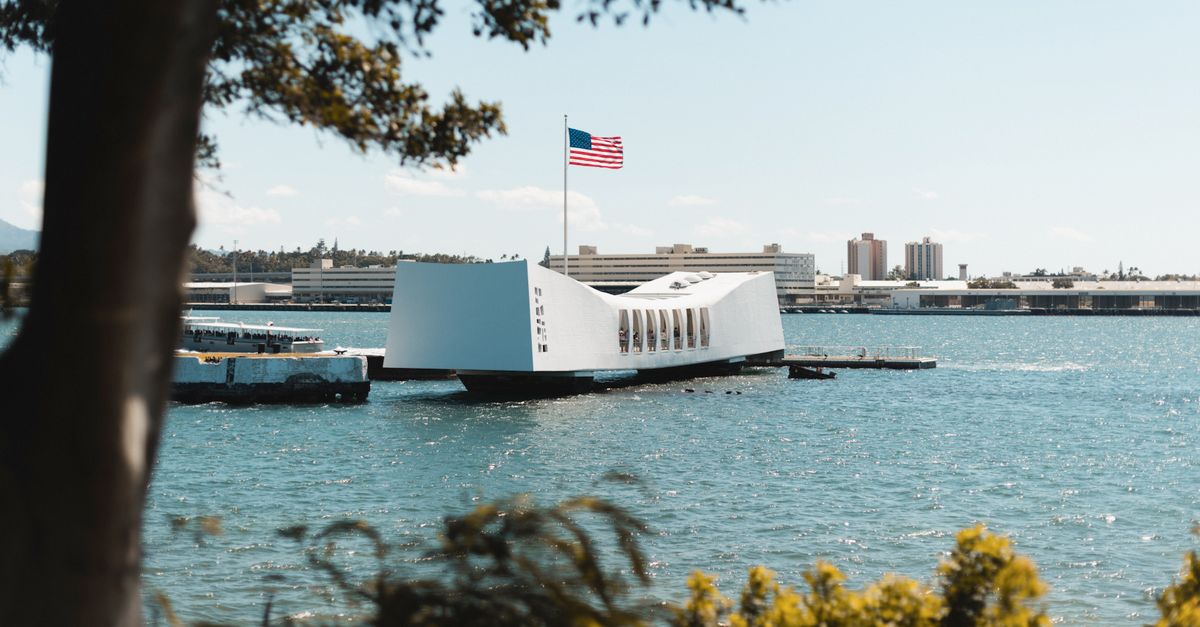
The USS Arizona Memorial marks the resting place of the battleship USS Arizona, sunk during the December 7, 1941 attack on Pearl Harbor, which killed 1,177 of the ship’s crew. Dedicated in 1962, the white structure spans the sunken hull without touching it and today serves as both a national shrine and a National Park Service site. Visitors arrive by boat, view the ship’s wreckage beneath the water, and read the names of the fallen on a marble wall inside the memorial.
Key takeaways
During the surprise Japanese attack on Pearl Harbor, a bomb penetrated the USS Arizona’s forward ammunition magazine, triggering a massive explosion that sank the battleship in minutes. Of the 1,177 sailors and Marines who died aboard, roughly two-thirds of the crew present that morning perished, making it the single greatest loss of life on any ship that day. The attack drew the United States into World War II the following day when Congress declared war on Japan. Details of the timeline and casualty figures are documented by the National Park Service, which administers the site alongside the U.S. Navy.
The memorial wasn’t built immediately — for years after the war, the wreck sat largely undisturbed as a visible reminder in the harbor. Construction on the current structure began in the late 1950s, and the memorial was formally dedicated on May 30, 1962. It was designed by Austrian-born architect Alfred Preis, who intentionally shaped the building to sag in the middle and rise at both ends, a form he described as symbolizing initial defeat followed by ultimate victory. The 184-foot structure is built directly over the sunken battleship but does not touch it, resting instead on pilings driven into the harbor floor.
Access to the memorial is only possible by a short boat ride operated by the National Park Service, departing from the visitor center on Ford Island’s shoreline. Once aboard the memorial, visitors pass through three main sections:
Because the memorial floats above an active gravesite, the National Park Service asks visitors to remain quiet and refrain from loud conversation, and swimwear or bare feet aren’t permitted on the tour.
One detail that surprises many first-time visitors is the thin sheen of oil that continues to surface from the Arizona’s submerged fuel bunkers, more than eight decades after the attack. Locally, this is sometimes called the “tears of the Arizona,” since the oil is often visible rippling on the water’s surface around the memorial. The wreck still holds a portion of the roughly 1.5 million gallons of fuel the battleship carried in 1941, and the National Park Service monitors the site for any change in the rate of seepage as part of its long-term preservation work.
Same-day walk-up tickets to the memorial are limited, and reservations can fill up weeks in advance, especially during peak travel season. Because of this, many visitors from Waikiki choose a guided option that includes a reserved ticket rather than risk arriving to a sold-out day. If you’re still deciding how to structure your trip, it helps to compare options for finding the right Pearl Harbor tour before booking, since some itineraries pair the memorial with Battleship Missouri or the Pacific Aviation Museum on Ford Island.
Security screening at the site is strict, similar to airport-level checks, and certain items aren’t allowed inside — it’s worth reviewing the Pearl Harbor bag policy before you go so you’re not turned away at the checkpoint with a bag you have to store or discard.
The boat ride and memorial visit itself typically takes less than an hour, but most visitors spend considerably longer at Pearl Harbor overall once you factor in the museum exhibits, the USS Bowfin submarine, and security lines. If you’re weighing whether to block out a half day or a full day for the visit, it’s worth reading through the tradeoffs of a half-day versus full-day Pearl Harbor tour so you can decide how much of Ford Island’s history you want to see beyond the memorial itself. Some travelers also ask whether the trip is worth the time commitment at all — a fair question addressed directly in an honest look at whether Pearl Harbor is worth visiting.
The USS Arizona Memorial is part of the larger Pearl Harbor National Memorial, which also includes the USS Utah Memorial and the USS Oklahoma Memorial, honoring sailors lost aboard those two ships as well. The Arizona’s memorial receives the most visitors by far and remains one of the most recognized war memorials in the country, a status reinforced by its listing as a National Historic Landmark. Surviving crew members of the Arizona were historically permitted to have their ashes interred within the ship’s wreckage upon their death, a practice that continued for decades after the attack, according to U.S. Navy history records.
Q: How many people died on the USS Arizona?
1,177 sailors and Marines were killed when the USS Arizona sank on December 7, 1941, out of roughly 1,512 personnel aboard that morning.
Q: When was the USS Arizona Memorial built?
The memorial was dedicated on May 30, 1962, after construction that spanned the final years of the 1950s into 1962.
Q: Can you still see the USS Arizona underwater?
Yes. Portions of the ship’s deck and structure are visible beneath the memorial’s open floor sections, and the wreck still slowly releases oil that surfaces near the site.
Q: Do you need a ticket to visit the USS Arizona Memorial?
Yes, entry is by timed reservation only, issued by the National Park Service or included through a licensed tour operator, since access is by boat in limited groups.
Q: Is the USS Arizona Memorial considered a cemetery?
Yes. More than 900 crew members remain entombed in the wreck, and the site is treated as an active military gravesite, which is why quiet, respectful behavior is expected throughout the visit.